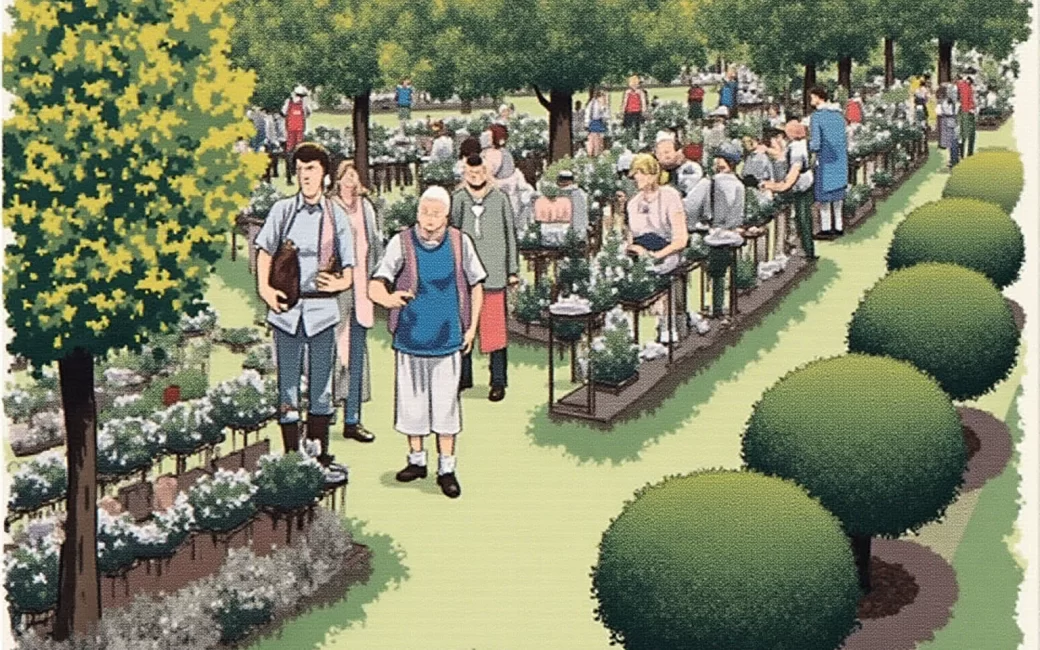
Searcher needs plants for their own region
A plant bought locally has already been filtered for the conditions it will have to survive — a national catalogue or a truck of stock shipped from another climate zone has not. Local hardiness depends on winter minimum temperatures, summer humidity, soil type and first/last frost dates, all of which vary enough between regions that a shrub thriving in one state can die outright in another.
A nursery that grows or holds stock in the region it sells to has already made the first cut for you. Green Things Nursery in Tucson, for instance, stocks species suited to low desert heat and alkaline soil, where a plant chosen for a humid-climate garden would struggle regardless of how well it's planted. Tallahassee Nurseries and Portland Nursery show the same pattern at opposite ends of the country: the trees, shrubs and perennials on their current lists are not identical, because what establishes in north Florida and what establishes in the Willamette Valley are not the same plants.
Staff at a local operation can usually say, from repeated seasons of selling the same stock into the same soil, which varieties fail and which don't — a judgment a big-box associate restocking a pallet shipped in from a central distribution warehouse is rarely positioned to make. That local knowledge is the actual value proposition of "nearby," more than convenience alone. Buying a plant that's already suited to your conditions is the single biggest lever against transplant failure, well before soil prep or watering technique comes into it.
Season changes (notably fall)
What a nursery has on the lot changes through the year, and visiting with the wrong season in mind is the most common reason a trip turns up nothing useful. Spring stock leans toward annuals, vegetable starts and early perennials; by fall, inventory shifts toward woody plants — trees, shrubs, and cool-season color like pansies and ornamental kale.
Fall is specifically recommended for planting trees and shrubs in many regions, because cooler air temperatures reduce transplant stress while soil stays warm enough for root growth to continue before winter dormancy. A tree or shrub put in the ground in autumn gets a full season of root establishment before it has to support leaf-out and summer heat the following year — an advantage a spring-planted equivalent doesn't get. Bates Nursery & Garden Center and Busy Bee Lawn & Garden Center both rotate stock seasonally for this reason, so a reader looking for bare-root fruit trees or balled-and-burlapped shade trees will generally find more selection in fall than in the height of summer, when annuals and bedding color dominate the tables instead.
The practical rule: match the shopping trip to the plant category. Go in spring for annuals and vegetable starts, and in fall for trees, shrubs and anything meant to establish roots before next year's growing season.
Shopper compares nursery prices to a big-box garden department
Price alone is the wrong comparison — stock age, growing conditions and what happens if the plant dies are the real differences, and they cut in different directions depending on what's being bought.
| Independent nursery | Big-box garden department | |
|---|---|---|
| Stock origin | Often grown on-site or sourced regionally | Typically trucked in from large wholesale growers |
| Plant maturity | Wider range, including larger specimens | Skews toward small, young stock |
| Staff advice | Horticultural staff familiar with local conditions | Variable, often general retail staff |
| Guarantee | Often a longer or more specific replacement policy | Usually a standard limited-time return policy |
| Best for | Established trees, shrubs, perennials | Cheap annuals, bedding plants, seed packets |
A cheap annual that only needs to survive one season is a reasonable big-box buy — there's little cost in a failure. A tree or shrub meant to be in the ground for decades is a different calculation: a slightly higher price for a better-rooted, locally acclimated specimen is usually cheaper over time than replacing a big-box plant that never establishes. The decision rule is simpler than comparing receipts: buy short-lived color wherever it's convenient, and buy anything long-term from whichever source can tell you how that specific plant performs in your soil and climate.
What a garden center is, versus a nursery
The terms get used interchangeably, but they describe different businesses. A garden center is primarily a retail outlet — it sells plants alongside supplies like soil, tools, pots and fertilizer, and much of its stock is bought in from wholesale growers rather than raised on the premises. A plant nursery, strictly speaking, grows plants itself, often on adjoining land, and sells from that stock directly.
In practice many businesses do both, which is why Rainbow Gardens and Boise Garden Center present themselves as garden centers while also functioning as growers and regional plant sources. The distinction matters mainly for one question worth asking before a visit: is this stock grown here, or trucked in? A plant grown on-site has already spent its life in the local climate; one trucked in from a grower three states away has not, even if it's being sold ten minutes from home.
Evaluating a nursery before you go
A few checks, done before or during a visit, separate a nursery worth returning to from one that's just moving inventory:
- Plant health on arrival — look for even leaf color, no wilting, and root systems that aren't circling tightly inside the pot (a sign of having sat too long).
- Guarantee policy — ask whether a dead plant is replaced, refunded, or neither; policies vary widely and are worth confirming before buying anything expensive.
- Local versus trucked-in stock — ask directly whether trees and shrubs were grown on-site or shipped in; both can be fine, but it changes how acclimated the plant already is.
- Staff knowledge — a quick question about whether a specific plant suits your yard's sun exposure or soil is a fast way to gauge whether advice is specific or generic.
The "3-year rule" and what to expect after buying
The "sleep, creep, leap" pattern describes how perennials typically grow in after planting: the first year they mostly establish roots and show little top growth ("sleep"), the second year growth is modest ("creep"), and by the third year they reach their expected mature size and bloom ("leap"). It's a guideline for patience, not a guarantee — some perennials establish faster, others slower, depending on species and conditions.
What it means practically for a buyer: a perennial that looks unimpressive in its first season after planting hasn't necessarily failed. Judging a plant on first-year performance alone, especially against a big-box annual blooming the same week it's bought, compares two different timelines. Ask nursery staff how a specific perennial is expected to perform in year one before deciding whether it's underperforming.
Before the next trip, decide what you're actually shopping for — a short-season color fix, or something meant to be in the ground for years — and let that decision, not the storefront, determine where to buy it.